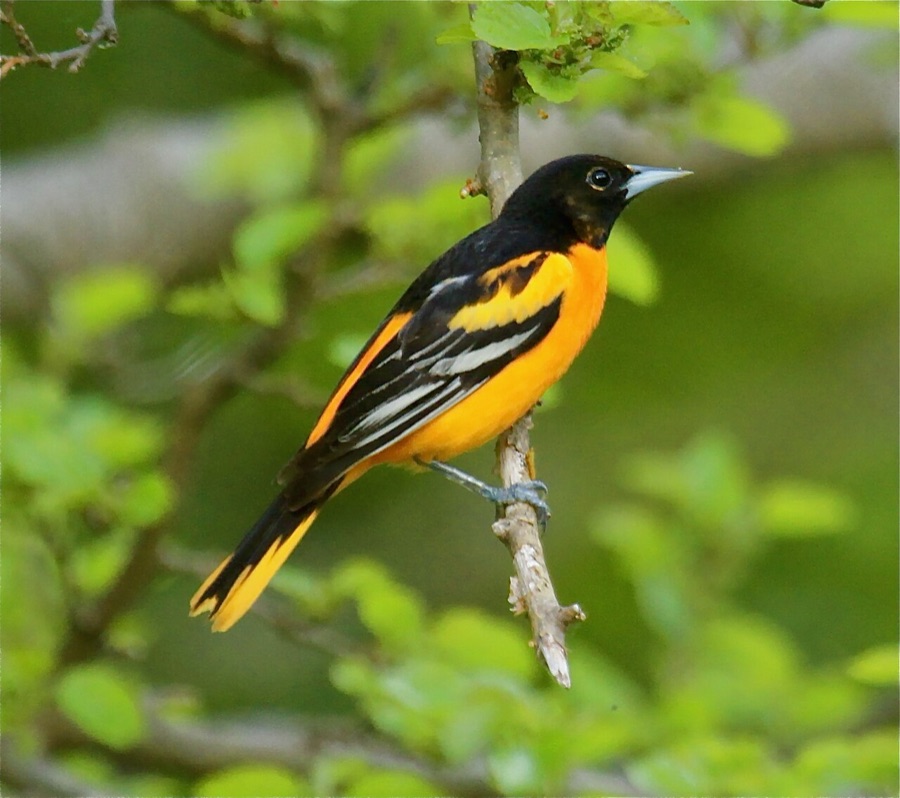
Orioles
Baltimore Oriole
Icterus galbula
Orioles take a weaker sugar mix than hummingbirds — about one part sugar to six parts water — and also visit fruit, especially orange halves.
- Food to offer
- Nectar
- Fruit
- Feeder that suits it
- Nectar feeder or fruit tray
- Size
- Medium
- When to expect it
- Spring to autumn (eastern North America)
- Region
- East
Photos of Baltimore Oriole
4 imagesFeeding Baltimore Oriole at a glance
For someone putting out food for the first time.
What to put out
- Nectar at one part sugar to six parts water
- Orange halves
- Fruit and jelly
Best feeder and placement
Dedicated oriole feeder, or a fruit tray.
How it behaves at the feeder
Visits fruit and weak nectar, often from a perch rather than hovering.
How to recognise it
Male brilliant orange with a black hood and black wings. Female yellow-orange with two white wing bars.
Often confused with
Bullock's Oriole — Bullock's male has a black crown and eyeline with a large white wing patch; Baltimore has a full black hood.
One thing to watch
Use a weaker mix than for hummingbirds, and skip jelly if it attracts wasps or spoils.
A different nectar ratio
FeederWatch notes that orioles take a slightly more diluted mixture than hummingbirds — about one part sugar to six parts water, rather than four.
That is worth knowing because a hummingbird feeder will still attract them, but it is not the ideal offer. A dedicated oriole feeder or a fruit tray is better.
Fruit is the reliable draw
Orange halves are the classic offering, and FeederWatch notes that oranges cut in half often attract orioles, which sip the juice and eat the flesh. Fruit is taken readily, and jelly is often used by feeders — though it spoils and attracts wasps.
If you want to keep it simple: an orange half on a spike or a fruit tray, changed often, will do more than a sugar feeder.
Oriole feeding at a glance
| Offer | Ratio or form | Notes |
|---|---|---|
| Sugar water | 1 part sugar : 6 parts water | Weaker than hummingbird mix |
| Orange half | Fresh fruit | Classic and reliable; replace when it spoils |
| Jelly | Plain, no additives | Attracts wasps; change frequently |
| Fruit | Grapes, berries | No preservatives |
Common questions
Can I use hummingbird nectar for orioles?
They will use it, but the recommended oriole mix is weaker — about one part sugar to six parts water.
What is the single best offering?
An orange half, replaced often. It is simple, cheap, and reliably used.
Why do they disappear in late summer?
They are summer breeders and migrants. Departure in late summer and autumn is normal.