Orioles
Bullock's Oriole
Icterus bullockii
The western oriole, with a similar taste for weak nectar and fruit. Orange halves and a dedicated oriole feeder work well.
- Food to offer
- Nectar
- Fruit
- Feeder that suits it
- Nectar feeder or fruit tray
- Size
- Medium
- When to expect it
- Spring to autumn (western North America)
- Region
- West
Photos of Bullock's Oriole
2 imagesFeeding Bullock's Oriole at a glance
For someone putting out food for the first time.
What to put out
- Nectar at one part sugar to six parts water
- Orange halves
- Fruit
Best feeder and placement
Oriole feeder or fruit tray.
How it behaves at the feeder
Takes weak nectar and fruit, often feeding from a perch.
How to recognise it
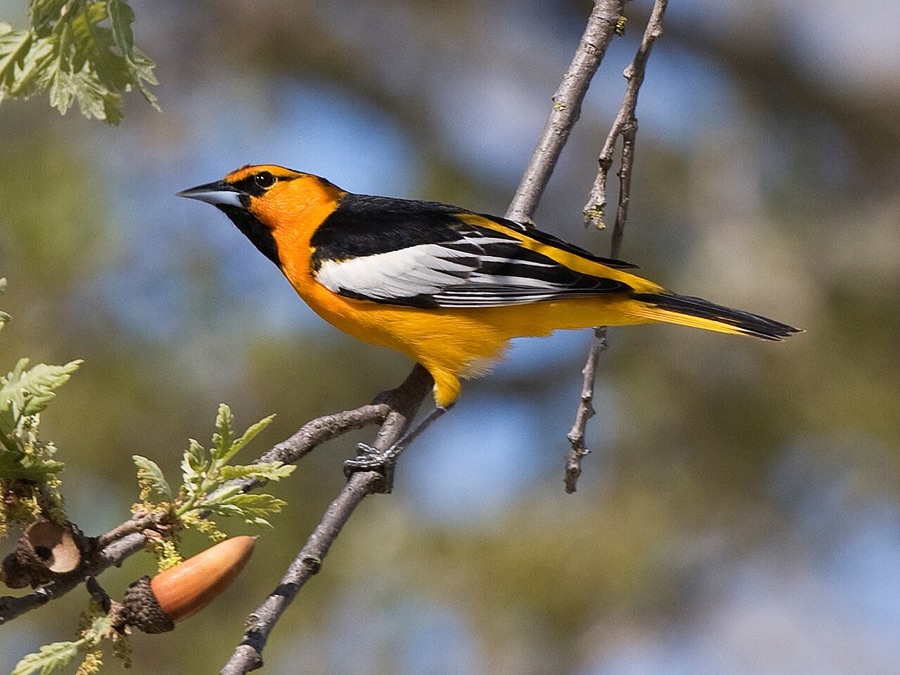
Male orange with a black crown, eyeline and throat patch, and a large white wing patch. Female is duller yellow-grey.
Often confused with
Baltimore Oriole — Baltimore male has a full black hood; Bullock's has a black crown and eyeline with orange between.
One thing to watch
A western oriole. Orange halves are the simplest reliable offering.
The western counterpart
Males are orange with a black crown, a black eyeline and a black throat patch, plus a large white wing patch. Baltimore Orioles have a full black hood instead.
Females are duller yellow-grey and much harder to separate; range is the practical guide.
Feeding
Like Baltimore Orioles, they take a weaker sugar mix — about one part sugar to six parts water — and visit fruit readily. Orange halves are the simplest reliable offering.
A dedicated oriole feeder keeps the weaker mix separate from a hummingbird feeder, which is cleaner than trying to compromise on one ratio.
Common questions
How do I tell it from a Baltimore Oriole?
Bullock's male has a black crown and eyeline with orange between them; Baltimore male has a full black hood. Range also separates them.
What should I put out?
Weak sugar water and fruit, especially orange halves.
Do they migrate?
Yes, they are summer breeders in the west and move south for winter.