Doves
Eurasian Collared-Dove
Streptopelia decaocto
An introduced dove that has spread rapidly. It feeds on the ground and on open platforms, often in pairs, and takes millet and cracked corn.
- Food to offer
- Millet & corn
- Mixed seed
- Feeder that suits it
- Ground or platform
- Size
- Medium
- When to expect it
- Year-round (expanding range)
- Region
- Widespread
Photos of Eurasian Collared-Dove
2 imagesFeeding Eurasian Collared-Dove at a glance
For someone putting out food for the first time.
What to put out
- Millet
- Cracked corn
- Mixed seed
Best feeder and placement
Ground or platform.
How it behaves at the feeder
Feeds on the ground in pairs, often alongside Mourning Doves.
How to recognise it
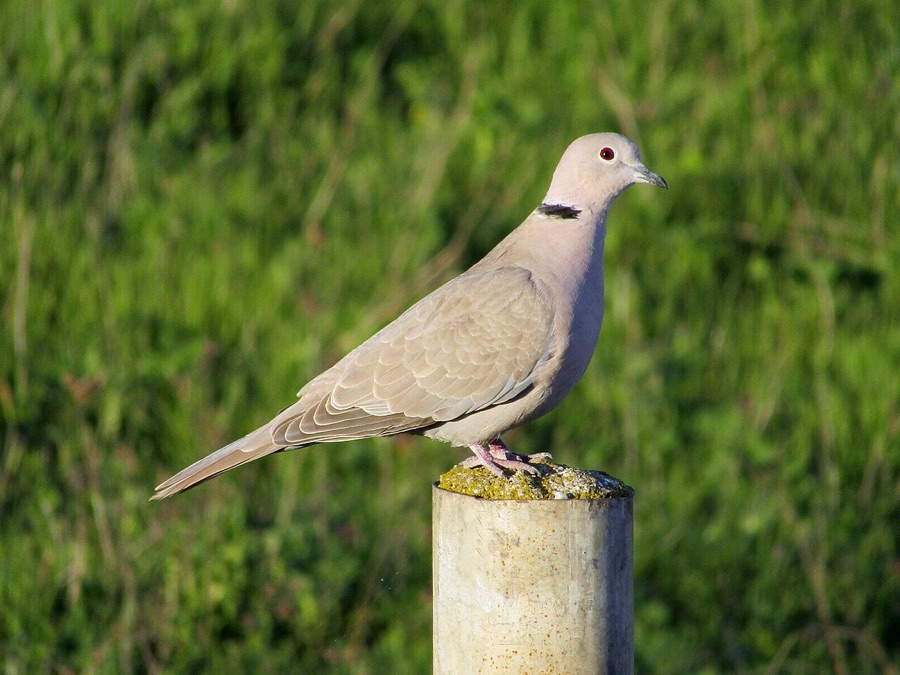
Pale grey-buff dove with a narrow black half-collar on the back of the neck and a square-tipped tail.
Often confused with
Mourning Dove — Mourning Dove has black wing spots and a long pointed tail; Collared-Dove has the neck collar.
One thing to watch
An introduced species that has spread rapidly. It uses open ground and trays readily.
The collar is the mark
Pale grey-buff overall, with a narrow black half-collar on the back of the neck and a square-tipped tail. Mourning Doves have black spots on the wing and a long pointed tail.
The collar is usually obvious, especially when the bird is perched or feeding on the ground.
A ground feeder that arrived and stayed
This species is not native to North America, but it has spread widely and now uses towns, farms and suburbs. It feeds on the ground and on open platforms, often in pairs.
Millet and cracked corn are the standard offerings. A low tray or ground scatter suits it; a small tube does not.
Common questions
Is it native?
No. It is an introduced species that has spread across much of North America.
How do I tell it from a Mourning Dove?
The black half-collar and the square-tipped tail. Mourning Doves have wing spots and a pointed tail.
Will it use a hanging feeder?
Rarely. It is a ground and platform feeder.