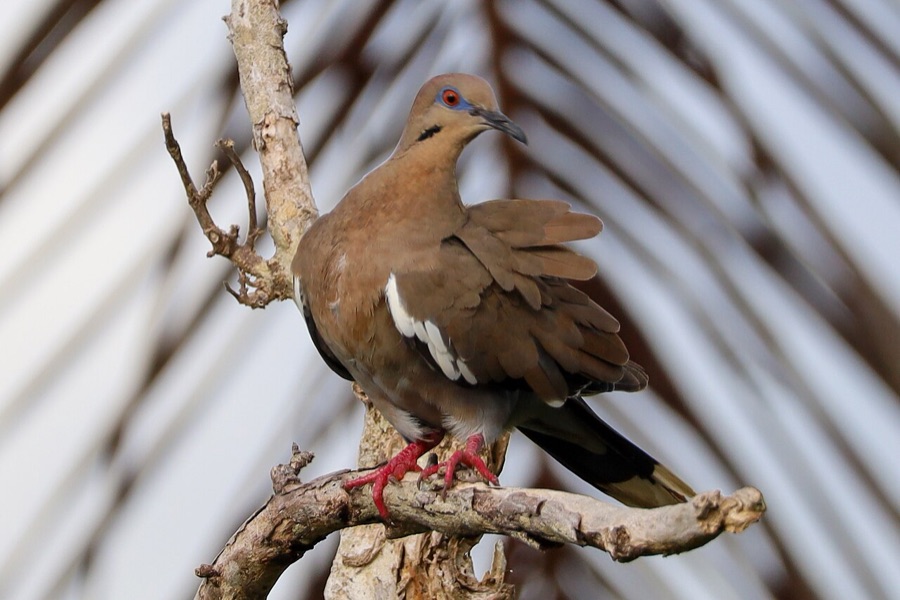
Doves
White-winged Dove
Zenaida asiatica
A large dove of the southwest that has moved into towns and suburbs. It uses platform and ground feeding readily, and visits nectar feeders in some areas.
- Food to offer
- Millet & corn
- Mixed seed
- Feeder that suits it
- Ground, platform or large hopper
- Size
- Medium
- When to expect it
- Year-round in the south; expands north in summer
- Region
- Southwest
Photos of White-winged Dove
4 imagesFeeding White-winged Dove at a glance
For someone putting out food for the first time.
What to put out
- Millet
- Cracked corn
- Mixed seed
- Nectar, occasionally
Best feeder and placement
Ground, platform or large hopper.
How it behaves at the feeder
A large dove that uses ground feeding and platforms readily, often in groups.
How to recognise it
Grey-brown dove with a bold white wing patch and a blue orbital ring around the eye.
Often confused with
Mourning Dove — White-winged has a large white wing patch and blue eye ring; Mourning has black wing spots.
One thing to watch
A southwestern bird that has moved into towns. It will use platform feeders and even nectar feeders in some areas.
Two marks
A bold white patch across the wing and a blue ring around the eye. The bird is grey-brown overall with a fairly long tail, and it is larger than a Mourning Dove.
In flight the white wing patch is conspicuous, which is often how people first notice the bird.
A ground and platform feeder
It uses ground feeding and platforms readily, often in groups. Millet and cracked corn are the standard offerings, and it will visit large hoppers as well.
In some areas it also visits nectar feeders, which is unusual for a dove and worth knowing if you keep one out.
Common questions
Where will I see one?
The southwest, and increasingly in towns within that range. It has expanded into urban areas.
Do they use nectar feeders?
Sometimes, which is unusual for a dove. Millet and corn are the more typical offerings.
How do I tell it from a Mourning Dove?
The white wing patch and blue eye ring. Mourning Doves have black wing spots and no eye ring.