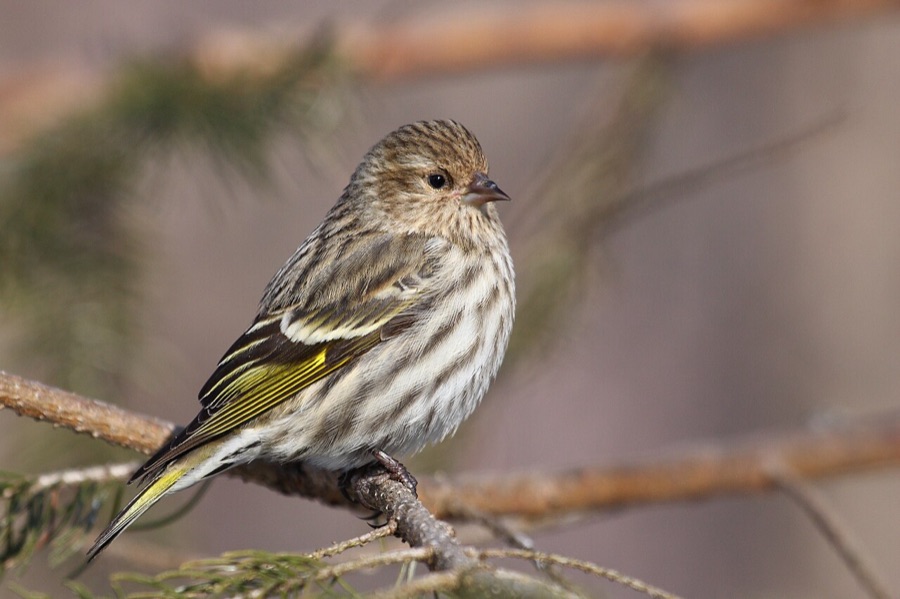
Finches
Pine Siskin
Spinus pinus
A streaky, aggressive little finch that turns up in variable numbers from year to year. When present, it can dominate a nyjer feeder.
- Food to offer
- Nyjer
- Sunflower
- Feeder that suits it
- Nyjer feeder or small tube
- Size
- Small
- When to expect it
- Irruptive; often winter
- Region
- Widespread
Photos of Pine Siskin
2 imagesFeeding Pine Siskin at a glance
For someone putting out food for the first time.
What to put out
- Nyjer
- Black-oil sunflower
- Hulled sunflower
Best feeder and placement
Nyjer feeder or small tube.
How it behaves at the feeder
Streaky, aggressive and often in flocks. In some years it dominates a nyjer feeder; in others it barely appears.
How to recognise it
Small and streaky brown with a sharply pointed bill and, in flight, flashes of yellow in the wings and tail.
Often confused with
Common Redpoll — Redpoll has a red poll and a black chin; Pine Siskin has neither and shows yellow wing flashes.
One thing to watch
Irruptive. Numbers swing wildly between years; a missing year is not a failure.
Why some years are different
Siskins are irruptive. Their movements track the seed crops of northern conifers rather than a fixed calendar, so numbers at any one feeder swing widely between years. A winter with none is not a failure, and a winter with dozens is not a permanent change.
That makes them a good example of a general rule at the feeder: the calendar tells you what is possible, not what will happen.
Identification, and the yellow flash
Pine Siskins are small, heavily streaked brown finches with a sharply pointed bill. The clincher is often in flight: flashes of yellow at the base of the wing and tail. At a feeder they can look like a very streaky, small sparrow until the yellow shows.
They are also aggressive for their size and will hold a port against larger birds.
What to put out
Nyjer is the classic offering, fed on its own in a small-port feeder. Black-oil and hulled sunflower are also taken. Because siskins arrive in flocks, a single small feeder can become very crowded very quickly — which is exactly the condition that spreads disease.
A second feeder, or more space between feeders, is a practical response to a flock rather than a bigger single feeder.
Common questions
Why were there none this year?
Siskins are irruptive and follow northern seed crops. Absence in a given winter is normal.
How do I tell a siskin from a sparrow?
The pointed finch bill and the yellow wing and tail flashes in flight. Sparrows have different bill shapes and no yellow flashes.
Should I stop feeding if siskins look sick?
Take down the feeders the sick bird was using for a couple of weeks, clean thoroughly, and contact a rehabilitator. FeederWatch notes that removal helps most where few people nearby feed.