Finches
Purple Finch
Haemorhous purpureus
More often a winter feeder bird in settled areas. It is easily confused with the house finch; the note is commonly confused with the house finch in both directions.
- Food to offer
- Sunflower
- Nyjer
- Feeder that suits it
- Tube or hopper
- Size
- Small
- When to expect it
- Winter in many areas; breeds in the north
- Region
- North and east
Photos of Purple Finch
2 imagesFeeding Purple Finch at a glance
For someone putting out food for the first time.
What to put out
- Black-oil sunflower
- Nyjer
- Hulled sunflower
Best feeder and placement
Tube or hopper.
How it behaves at the feeder
Often a winter feeder bird in settled areas. Less aggressive than House Finch and easily displaced.
How to recognise it
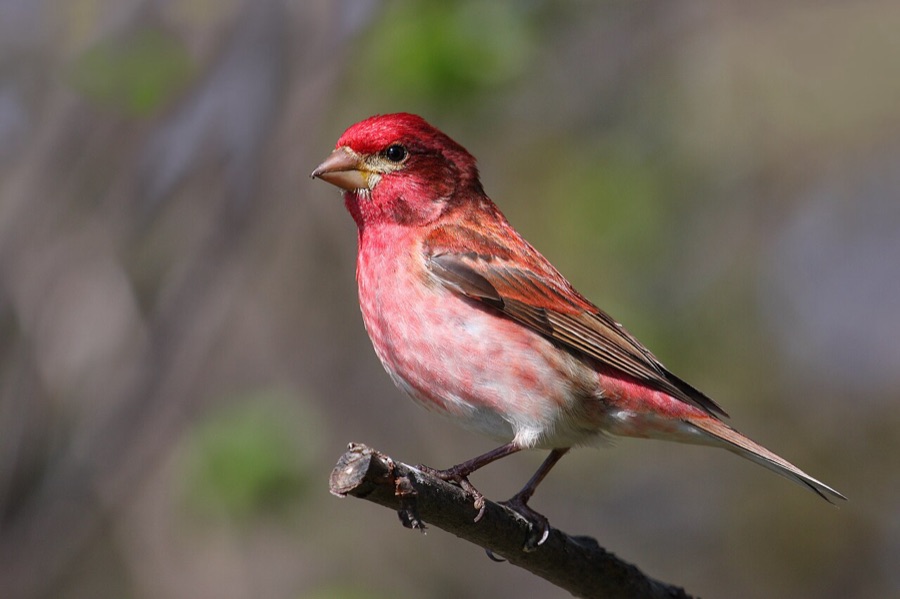
Males are raspberry-red across the head and breast with a brown back. Females are brown and heavily streaked with a bold face pattern.
Often confused with
House Finch — House Finch has streaked flanks and a more orange-red tone; Purple Finch is more uniformly raspberry-red above.
One thing to watch
If House Finches dominate your feeder, Purple Finches may be visiting briefly or not at all.
House Finch or Purple Finch?
This is the identification most feeder owners get wrong. Look at the flanks, the face and the back rather than the shade of red.
Purple Finch
- Raspberry-red over the head, breast and back
- Back is brown but the red extends across it
- Flanks are not strongly streaked
- Females have a bold face pattern with a strong eyebrow stripe
House Finch
- More orange-red, concentrated on head and breast
- Brown, streaked back
- Distinct brown streaking on the flanks
- Females are plain-faced and streaked, without the bold eyebrow
Why it is less predictable than a House Finch
Purple Finches are not the dependable feeder bird that House Finches are. In much of the settled east and midwest they are more often winter birds, and their numbers at feeders fluctuate. House Finches, by contrast, are resident and adaptable almost everywhere.
That difference matters when you are identifying one. A finch that appears for a few weeks in late autumn, feeds heavily and then disappears is more likely a Purple Finch than a new resident House Finch.
What to put out
Black-oil sunflower is the reliable offering. Nyjer is taken, and hulled sunflower works where mess is a concern. Purple Finches are generally less aggressive than House Finches and are easily displaced at a crowded feeder.
If House Finches dominate your setup, Purple Finches may be visiting briefly at the edges or not at all. A second feeder, slightly apart, can help.
Common questions
Is a Purple Finch actually purple?
No. Males are raspberry-red, often described as a deep pink-red. The name is historical rather than descriptive.
Why do I only see them in winter?
In much of the eastern and midwestern United States they are more often winter visitors, while House Finches are resident. A short seasonal appearance is normal.
Do they use nyjer?
Yes, along with sunflower. They are less likely to hold a feeder against House Finches, so food choice matters less than feeder position.