Chickadees & titmice
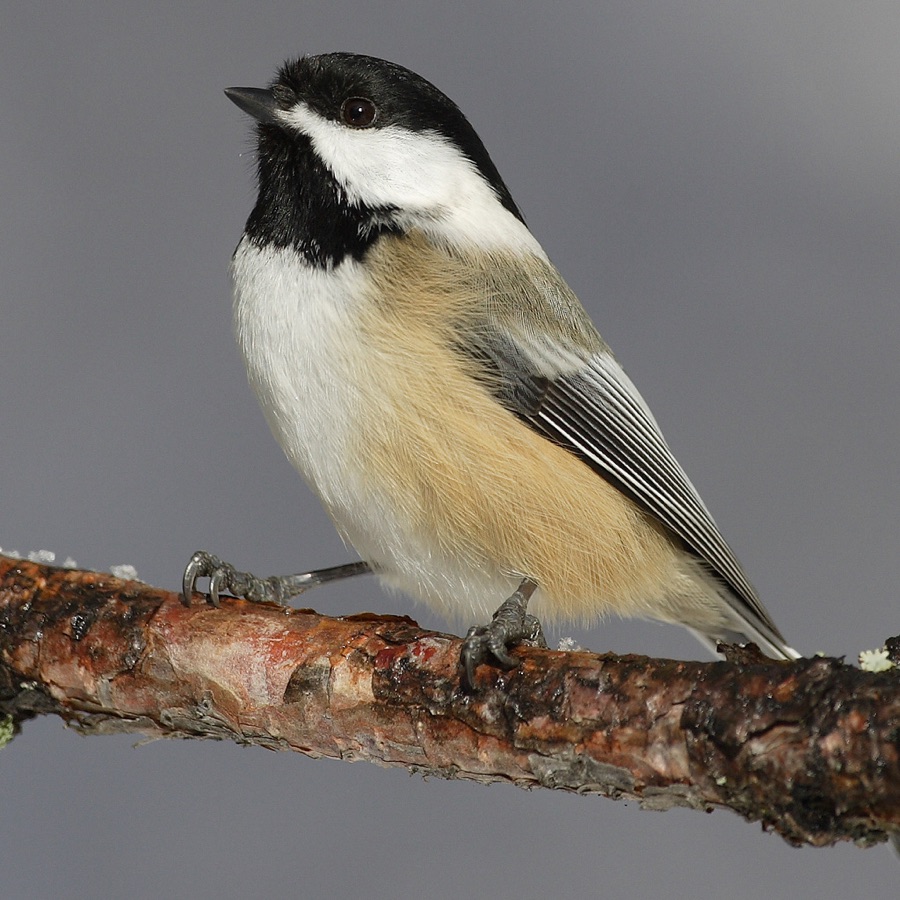
Black-capped Chickadee
Poecile atricapillus
Quick, acrobatic and usually the first bird to find a new feeder. Chickadees take sunflower, peanuts and suet, and happily cling upside down.
- Food to offer
- Sunflower
- Peanuts
- Suet
- Feeder that suits it
- Small tube or suet cage
- Size
- Small
- When to expect it
- Year-round (northern North America)
- Region
- North
Photos of Black-capped Chickadee
4 imagesFeeding Black-capped Chickadee at a glance
For someone putting out food for the first time.
What to put out
- Black-oil sunflower
- Peanuts
- Suet
Best feeder and placement
Small tube with short perches, or a suet cage. Short perches help exclude larger birds.
How it behaves at the feeder
Takes one seed and flies to a branch to hammer it open. Caches food in bark. Usually the first bird to find a new feeder.
How to recognise it
Black cap and black bib with white cheeks between them, grey back, buffy sides, small short bill.
Often confused with
Carolina Chickadee — Nearly identical; best separated by range. Carolina is slightly smaller with less white in the wing.
One thing to watch
In summer it eats mostly insects, so a quiet feeder is normal. Feeding matters most in winter.
A diet that changes with the calendar
Chickadees are not really seed-eaters. Audubon describes a diet that shifts sharply between seasons: in summer, vegetable matter — seeds and fruit — may be no more than about 10 percent of what they eat, with caterpillars, other insects, spiders and snails making up the rest. In winter, plant material can rise to roughly half the diet, alongside insect eggs and pupae.
That is why a feeder matters most in the cold months. In June you are offering a snack to a bird that is finding caterpillars. In January you are offering something closer to a staple.
Why it takes one seed and leaves
The take-a-seed-and-go behaviour is caching, not greed. Chickadees store food and recover it later, and they will wedge seeds into bark crevices to deal with them. It also explains why a small tube feeder with short perches suits them: they do not need to sit still, and short perches keep larger birds off.
This is also why a chickadee is often the first bird to find a feeder you have just hung. It forages by hopping through twigs and gleaning surfaces, including upside down, so a new object in the garden is something it will investigate quickly.
Chickadee or something else?
Three birds get confused with a chickadee at a feeder. The differences are mostly about the head and the bill.
Black-capped Chickadee
- Black cap and black bib, with white cheeks between them
- Gray back, buff wash on the sides
- Small, short bill
- Length roughly 5–6 in (12–15 cm)
Common look-alikes
- Carolina Chickadee — nearly identical; best separated by range
- Tufted Titmouse — has a pointed crest and no black cap
- Male House Sparrow — heavier bill, no black cap and bib pattern
What to put out
Black-oil sunflower is the workhorse. Peanuts — shelled or hearts — are taken readily, and suet is a strong winter draw. A small tube feeder, a suet cage, or a hopper all work; the bird's ability to cling upside down means a suet cage accessible only from below is no obstacle.
Nyjer is not a chickadee food. If you are buying a bag specifically for chickadees, sunflower is the better buy.
Common questions
Do chickadees migrate?
Mostly they are permanent residents. Audubon notes occasional autumn 'invasions' with large numbers moving south, mostly in the northeastern states and southeastern Canada, but these usually do not go far beyond the breeding range.
Why does my chickadee feeder go quiet in summer?
Because insects are abundant and plant material is a small part of the summer diet. A quiet feeder in June is normal, not a failure.
Will chickadees use a nest box?
Yes. They nest in cavities, often enlarging a small natural hole in rotten wood, and will use a nest box. Audubon puts typical nest height at 5–20 ft.