Chickadees & titmice
Mountain Chickadee
Poecile gambeli
A mountain and high-desert chickadee that comes readily to sunflower and suet. It often moves downslope in winter, which is when it is most likely in a garden feeder.
- Food to offer
- Sunflower
- Suet
- Peanuts
- Feeder that suits it
- Small tube or suet cage
- Size
- Small
- When to expect it
- Year-round (western mountains)
- Region
- West
Photos of Mountain Chickadee
4 imagesFeeding Mountain Chickadee at a glance
For someone putting out food for the first time.
What to put out
- Black-oil sunflower
- Suet
- Peanuts
Best feeder and placement
Small tube or suet cage.
How it behaves at the feeder
A quick, acrobatic feeder that often moves downslope in winter, which is when gardens see it.
How to recognise it
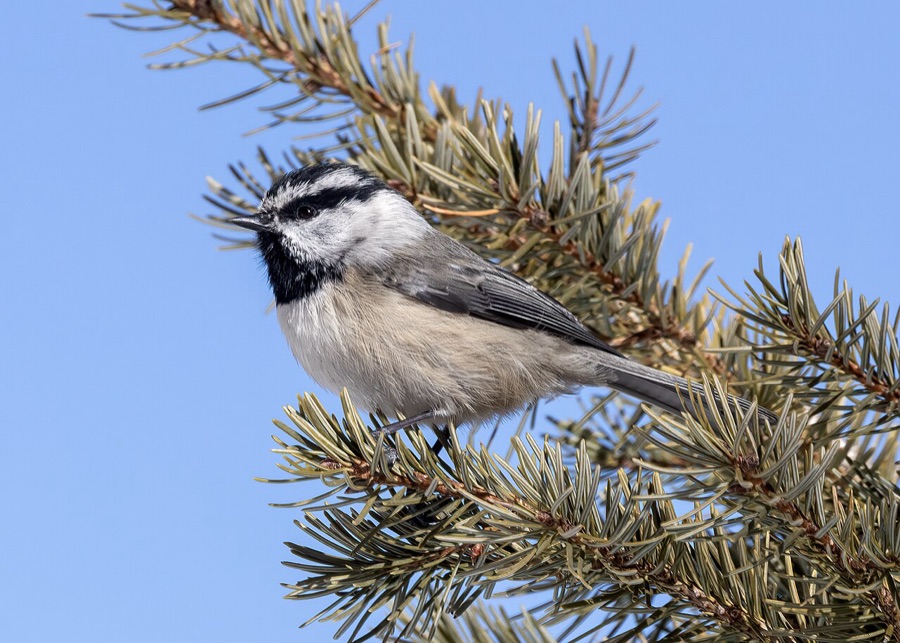
Black cap and bib with a striking white eyebrow stripe — the feature Black-capped and Carolina lack.
Often confused with
Black-capped Chickadee — The white eyebrow is the give-away; Black-capped has a plain white cheek without the stripe.
One thing to watch
A mountain and high-desert bird. In winter it may drop to lower elevations and appear in gardens.
The eyebrow
Black cap, black bib, white cheek, and a white stripe over the eye. That eyebrow is the difference, and it is visible at a feeder without binoculars.
The bird is a mountain and high-desert specialist. In winter it often moves downslope, which is when gardens at lower elevations see it.
Why it appears in winter
This is an elevational mover rather than a long-distance migrant. When snow covers high country, birds drop to lower elevations and turn up at feeders that never see them in summer.
So a winter appearance is not a range expansion. It is the same local population following food down the slope.
Common questions
How is it different from a Black-capped Chickadee?
The white eyebrow. Black-capped has a plain white cheek without a stripe above the eye.
Why do I only see it in winter?
It moves downslope when high-country food is buried. It is an elevational movement, not migration.
What should I put out?
Sunflower, suet and peanuts. A small tube or suet cage works well.