- Food to offer
- Nectar
- Feeder that suits it
- Nectar feeder
- Size
- Small
- When to expect it
- Spring to autumn (eastern North America)
- Region
- East
Photos of Ruby-throated Hummingbird
4 imagesFeeding Ruby-throated Hummingbird at a glance
For someone putting out food for the first time.
What to put out
- Nectar: one part white sugar to four parts water
- No dye, honey or sweetener
Best feeder and placement
Nectar feeder, easy to take apart. Clean every couple of days in warm weather.
How it behaves at the feeder
Territorial and fast. Will defend a feeder port and chase other hummingbirds away.
How to recognise it
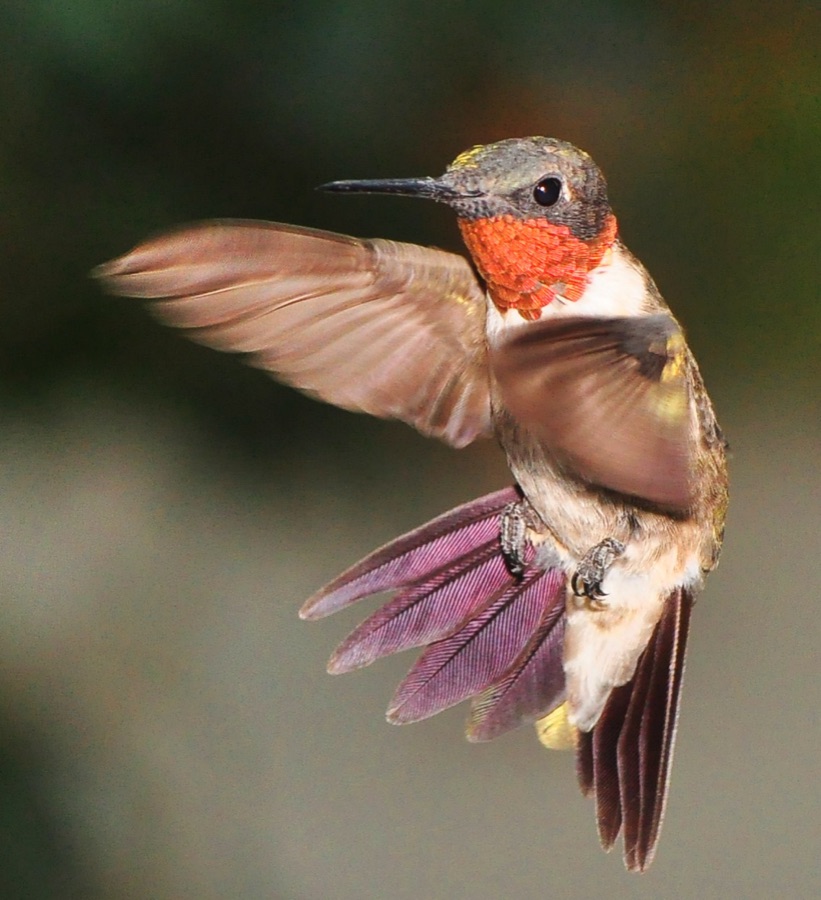
Males have a ruby-red throat that looks black in poor light. Females are green above with a pale throat.
Often confused with
Black-chinned Hummingbird — Black-chinned male has a dark chin with a purple band below; range and tail shape help.
One thing to watch
Mould grows quickly in sugar water. Cleaning matters more than the recipe.
Nectar calculator
Standard mix is one part sugar to four parts water, by volume.
0.8 cups sugar
Mixed with 3.2 cups of water — about 20% sugar by volume.
White sugar 0.8 cups Water 3.2 cups
Plain white sugar only — never honey, brown sugar or sweetener, and never red dye. Clean the feeder every couple of days in warm weather.
Making nectar
FeederWatch's method is one part sugar to four parts boiling water, stirred until dissolved.
- Boil the water.
- Stir in white sugar at one part sugar to four parts water.
- Let it cool completely before filling the feeder.
- Do not add red food colouring — FeederWatch states it is harmful to birds.
- A red portal or a red ribbon on the feeder is enough to attract them.
Cleaning is the actual skill
FeederWatch is blunt about why: mould and fungi grow readily in sugar water, particularly in warm temperatures. Their guidance is to clean hummingbird feeders even more frequently than seed feeders — every couple of days — and ideally every time you refill them.
If you see cloudy water or black mould, discard the solution and clean the feeder immediately. Take it apart, wash with warm water and dish soap, rinse thoroughly, and let it dry.
This is the reason a feeder that is easy to take apart is worth more than a decorative one. If cleaning is fiddly, it will not happen often enough.
Ratio by use
| Mix | Ratio | Notes |
|---|---|---|
| Standard hummingbird | 1 part sugar : 4 parts water | The default. Use this unless you have a reason not to. |
| Oriole mix | 1 part sugar : 6 parts water | Weaker; FeederWatch notes this for orioles. |
| Anything with dye | — | Do not use. Harmful to birds. |
Season and timing
In eastern North America the Ruby-throated is a spring-to-autumn bird, not a year-round resident. A common question is when to take the feeder down; a widely used rule is to keep it up until you have seen no hummingbirds for about two weeks. Leaving it up does not stop birds migrating.
If you garden for hummingbirds as well as feeding them, native plants that supply nectar and the insects hummingbirds also eat do more across the season than a feeder alone.
Common questions
Can I make a big batch and store it?
You can refrigerate spare nectar, but the feeder itself still needs frequent cleaning. Storing nectar does not remove the need to change what is in the feeder.
Should I use a feeder with a built-in ant moat?
An ant moat helps, but it does not replace cleaning. Ants are a sign the feeder is being used heavily, not a sign it is dirty.
Why does the solution go cloudy so fast?
Warm weather and sunlight speed spoilage. Move the feeder into shade if you can, and clean more often in hot spells rather than making a stronger mix.