- Food to offer
- Millet & corn
- Sunflower
- Feeder that suits it
- Ground or low platform
- Size
- Small
- When to expect it
- Winter (northern North America)
- Region
- North
Photos of American Tree Sparrow
3 imagesFeeding American Tree Sparrow at a glance
For someone putting out food for the first time.
What to put out
- Millet
- Black-oil sunflower
- Mixed seed
Best feeder and placement
Ground or low platform.
How it behaves at the feeder
A winter visitor that feeds on the ground and in low cover, often in small flocks.
How to recognise it
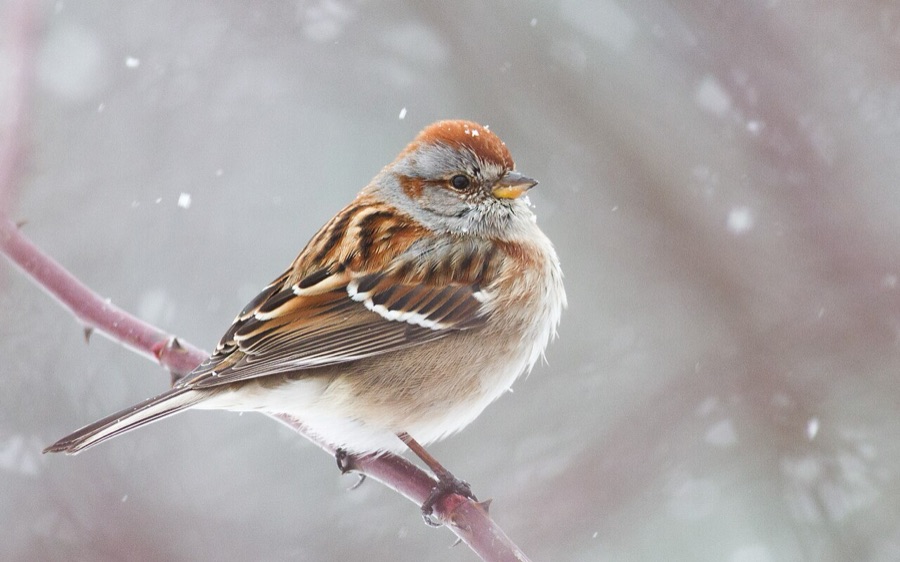
Rufous cap, grey face, a dark central breast spot and a bicoloured bill (dark above, yellow below).
Often confused with
Chipping Sparrow — Chipping has a black eyeline and a plain breast; Tree Sparrow has the breast spot and bicoloured bill.
One thing to watch
A bird of northern winters. It leaves as spring arrives.
The bicoloured bill
The upper mandible is dark and the lower is yellow, which gives the bird a two-tone bill. Add a rufous cap, a grey face and a dark central breast spot, and the identification is straightforward.
The name is misleading: it is not especially a tree bird, and it feeds on the ground in low cover.
A winter visitor
It breeds in the far north and winters across much of the northern United States and southern Canada. It leaves as spring arrives.
Millet and sunflower on the ground or a low tray are the standard offers. It often feeds in small flocks.
Common questions
Why is it called a tree sparrow if it feeds on the ground?
The name is traditional and not especially descriptive. It is a ground feeder in open and shrubby country.
How do I tell it from a Chipping Sparrow?
The bicoloured bill and the dark breast spot. Chipping Sparrows have a black eyeline and a plain breast.
When will I see one?
In winter across the northern states and southern Canada. It leaves in spring.