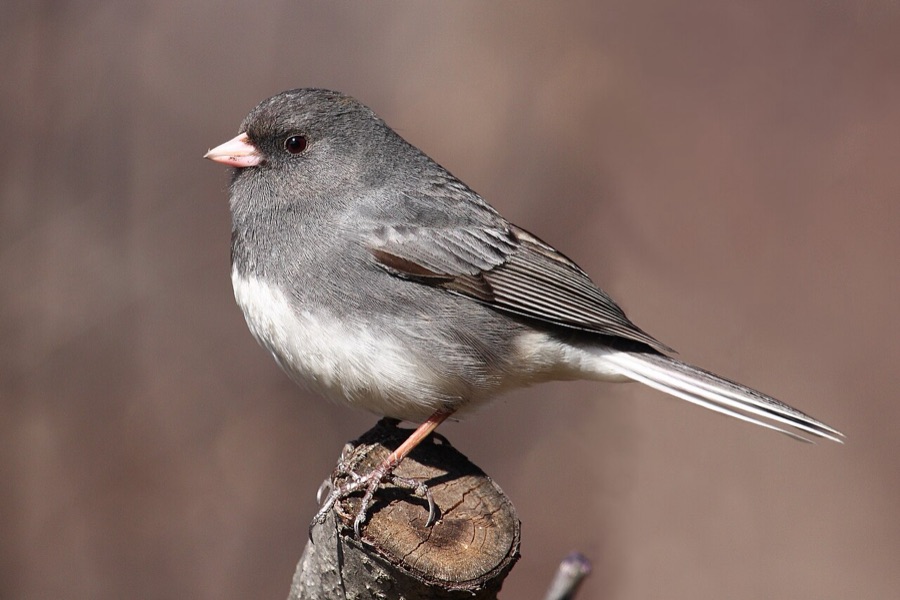
Sparrows & juncos
Dark-eyed Junco
Junco hyemalis
A winter bird in much of its range. Millet scattered on the ground or a low platform is the simplest way to keep juncos coming.
- Food to offer
- Millet & corn
- Sunflower
- Feeder that suits it
- Ground or low platform
- Size
- Small
- When to expect it
- Autumn to spring (winter visitor in many areas)
- Region
- Widespread
Photos of Dark-eyed Junco
4 imagesFeeding Dark-eyed Junco at a glance
For someone putting out food for the first time.
What to put out
- Millet
- Black-oil sunflower
- Hulled sunflower
Best feeder and placement
Ground or low platform. It is not a tube feeder bird.
How it behaves at the feeder
Feeds on the ground, often in flocks, and scratches in leaf litter. Arrives in autumn and leaves in spring in many areas.
How to recognise it
Slate-grey or brown above with a white belly, a pink bill and white outer tail feathers that flash in flight.
Often confused with
Chipping Sparrow — Chipping Sparrow has a rufous cap and black eyeline; junco has a plain grey head and pink bill.
One thing to watch
Ground seed attracts rodents. A low tray plus raking is cleaner than broadcasting.
One species, several looks
Juncos vary a lot by region. Eastern birds are slate-grey above with a white belly; western forms include brownish and dark-hooded variants. They were long considered separate species, and recent work treats them as one species with strong regional variation.
What they share is the shape: a small ground-feeding bird with a pink bill and white outer tail feathers that flash when it flies.
A ground feeder, not a tube bird
Juncos feed on the ground, often in flocks, and scratch in leaf litter. A low tray or scattered millet is far more effective than a hanging feeder.
Millet is the classic offering, with sunflower also taken. Because they feed low, a brush pile or shrub nearby makes the garden much more attractive.
Junco or sparrow?
| Feature | Dark-eyed Junco | Typical sparrow |
|---|---|---|
| Bill | Pink and small | Often darker, more conical |
| Head | Plain, no strong stripes | Often striped or capped |
| Tail | White outer feathers flash in flight | Usually no white flash |
| Feeding | Ground, often in flocks | Ground or cover |
Common questions
Why do juncos appear only in winter?
In much of their range they are winter visitors, moving south or downslope as the season turns. Spring departure is normal.
What should I put out?
Millet on the ground or a low tray, with sunflower also taken.
Why are there different-looking juncos?
Regional colour forms. They are treated as one species with strong variation rather than several species.