Woodpeckers
Downy Woodpecker
Dryobates pubescens
The smallest North American woodpecker. A suet cage, especially one accessible from below, lets it cling and feed while excluding starlings.
- Food to offer
- Suet
- Peanuts
- Sunflower
- Feeder that suits it
- Suet cage
- Size
- Small
- When to expect it
- Year-round (much of North America)
- Region
- Widespread
Photos of Downy Woodpecker
4 imagesFeeding Downy Woodpecker at a glance
For someone putting out food for the first time.
What to put out
- Suet
- Peanuts
- Black-oil sunflower
Best feeder and placement
Suet cage, especially one accessible from below. Small tube for sunflower.
How it behaves at the feeder
Clings and feeds acrobatically, often upside down. Small enough to work twigs and weed stalks.
How to recognise it
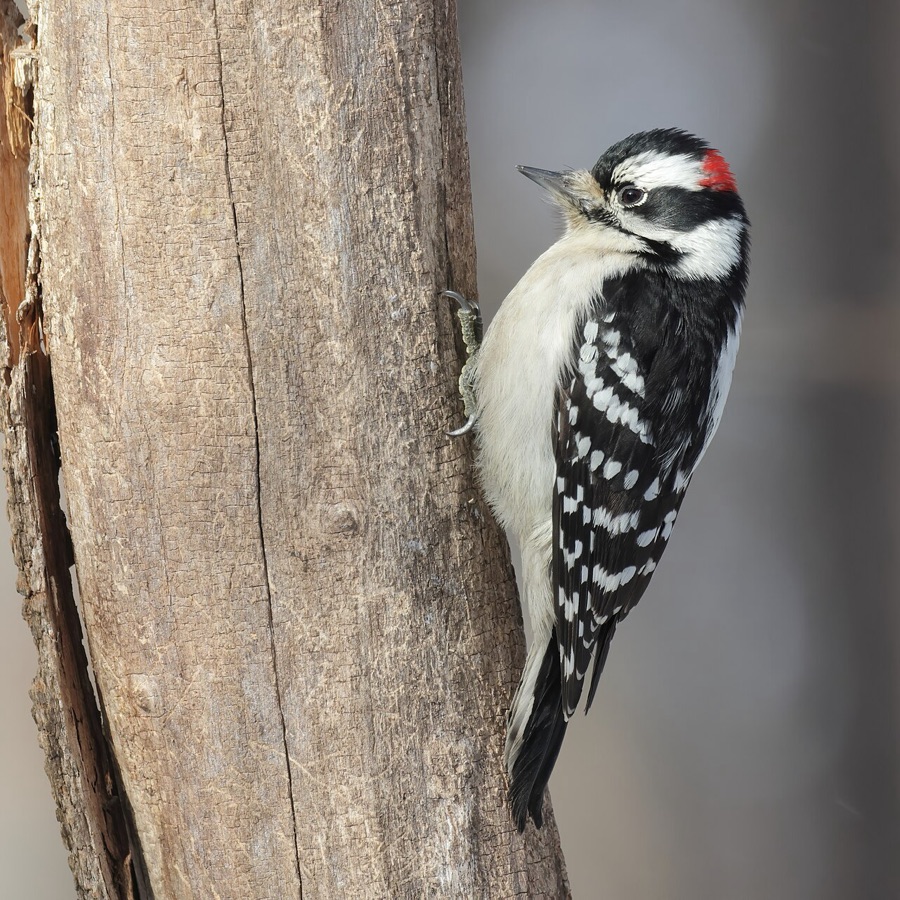
Small black-and-white woodpecker with a very short, stubby bill. Male has a red nape spot; female has none.
Often confused with
Hairy Woodpecker — Hairy is larger with a bill nearly as long as its head; Downy's bill is short and stubby.
One thing to watch
Suet that has gone soft or rancid should be replaced. A dirty cage is worse than an empty one.
Downy or Hairy? The bill is the answer
These two are the classic woodpecker confusion. Audubon describes the Downy's bill as 'very short, stubby'. The Hairy's bill is roughly as long as its head. If you can see the bill clearly, you can identify the bird.
Downy Woodpecker
- Very short, stubby bill
- Length 5–7 in (12.7–17.8 cm)
- Weight 0.7–1.0 oz (19.8–28.3 g)
- Small black bars on the white outer tail feathers
Hairy Woodpecker
- Bill about as long as the head
- Noticeably larger overall
- Outer tail feathers plain white
- Often at the same feeders, but less frequent in towns
A woodpecker that uses twigs and weeds
Most woodpeckers are birds of trunks and major limbs. The Downy's small size lets it work minor branches and twigs, hang upside down, and even forage on shrub stems and weed stalks. Audubon notes that it does more tapping and excavating on trees in winter and more surface gleaning in summer.
In winter it often joins mixed flocks of chickadees and nuthatches moving through woodland — which is one reason a garden with several feeder types sees more of it.
What actually brings it in
Suet. A cage accessible from below suits woodpeckers, nuthatches and chickadees while making life harder for starlings, which is the arrangement FeederWatch recommends for exactly this reason.
Peanuts and sunflower are also taken. But if you are choosing one thing to hang for a Downy, suet is the reliable answer, and a cage low enough to cling to from underneath is better than a flat tray.
Resident, with local movements
Downies are permanent residents across much of their range, but Audubon notes that northernmost populations may move some distance south in winter, and birds in the Rockies and other western mountains may drop to valleys. So a winter increase at your feeder can be local movement rather than migration.
Nesting is in a cavity excavated by both sexes in a dead limb or dead tree, usually 12–30 ft up, with an entrance often camouflaged by fungus or lichen. Audubon gives 4–5 eggs, incubation about 12 days by both sexes, and young leaving the nest at about 20–25 days.
Common questions
Is it a problem if a woodpecker drums on my house?
Drumming is communication, not necessarily feeding. Audubon describes pairs taking turns drumming loudly on dead limbs on separate territories, with the male gradually approaching. On siding it can still cause damage, so if it persists, physical deterrents are the usual route rather than removing feeders.
Will suet go rancid in summer?
Ordinary suet can. FeederWatch advises care with suet in hot weather unless it has been specially processed. In warm months, either use a warm-weather formulation or take the cage down.
Do Downies eat seeds?
Yes, though insects dominate. Audubon lists beetles and ants especially, plus gall wasps and caterpillars, with seeds and berries taken as well.