Woodpeckers
Pileated Woodpecker
Dryocopus pileatus
The largest North American woodpecker. It needs a substantial suet feeder and mature trees nearby; a small cage is unlikely to hold its attention.
- Food to offer
- Suet
- Peanuts
- Feeder that suits it
- Large suet cage
- Size
- Large
- When to expect it
- Year-round (forested regions)
- Region
- Widespread
Photos of Pileated Woodpecker
4 imagesFeeding Pileated Woodpecker at a glance
For someone putting out food for the first time.
What to put out
- Suet
- Peanuts
Best feeder and placement
Large, substantial suet cage.
How it behaves at the feeder
Carpenter ants may be up to 60% of its diet, so it is usually working dead wood rather than feeders.
How to recognise it
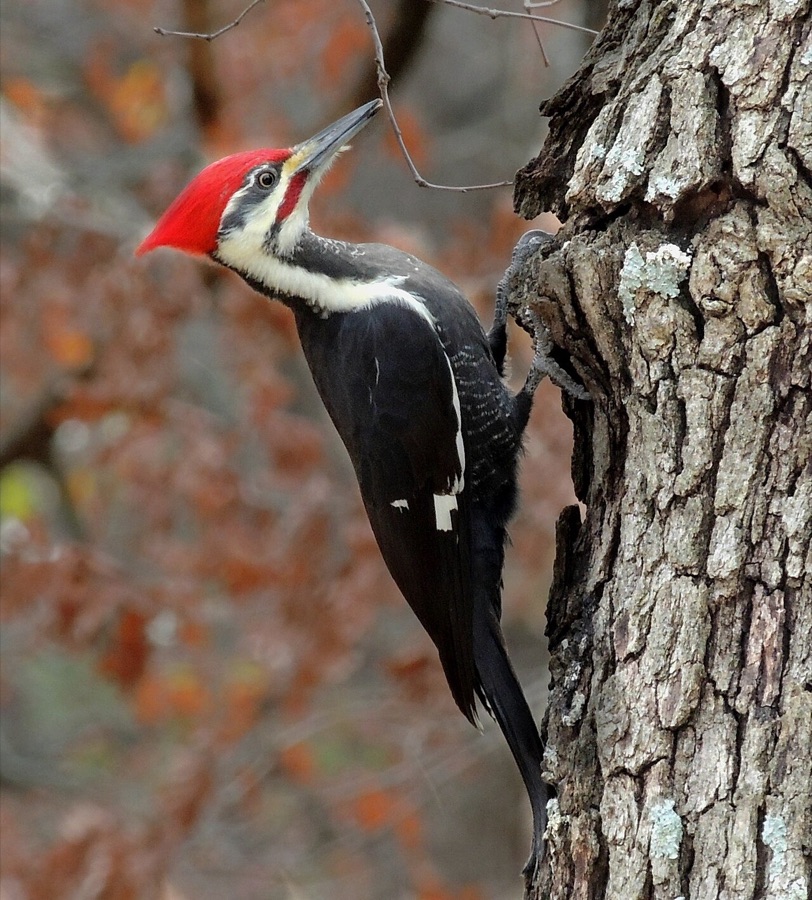
Crow-sized and mostly black with a flaming red crest and a white neck stripe. White flashes under the wings in flight.
Often confused with
Northern Flicker — Flicker is brown and spotted; Pileated is mostly black with a full red crest and much larger.
One thing to watch
Leaving a safe standing dead tree does far more for this bird than any feeder.
Size, and what it means for a feeder
Length is 16–19 in (40–49 cm), wingspan 2 ft 2 in to 2 ft 5 in (66–75 cm), weight 8.8–12.3 oz (250–350 g). Audubon describes it as favouring mature deciduous or mixed forest, and also occurring in second-growth and fragmented woodlots as long as some large trees are present.
At that size, a small suet cage is unlikely to hold its attention. If you are putting something out for a Pileated, it needs to be substantial — and even then, the bird's real food is in dead wood, not in a feeder.
Carpenter ants, up to 60 percent
Audubon gives a striking figure: carpenter ants may be up to 60 percent of the Pileated's diet. It also eats other ants (rarely digging into anthills on the ground), termites, larvae of wood-boring beetles and other insects. About a quarter of the diet may be wild fruits, berries and nuts.
The feeding method explains the holes. It probes, pries and excavates in dead wood, sometimes gouging deep holes in rotten wood to reach ant nests and tearing apart stumps and large sections of fallen logs. Those rectangular excavations are the field mark people notice after the bird has gone.
Nesting and territory
| Detail | Figure |
|---|---|
| Eggs | 3–5, white |
| Incubation | About 18 days, both sexes (male at night and part of day) |
| Young leave nest | 26–28 days, may stay with parents 2–3 months |
| Nest height | Usually 15–80 ft |
| Cavity | New cavity generally each year, excavated by both sexes |
What actually attracts one
Dead wood. Audubon describes the nest site as a cavity in a dead tree or in a dead branch of a live tree, sometimes a utility pole. The bird forages in dead wood and fallen logs. A garden that removes every snag and stump removes the habitat.
Where it is safe to do so — away from buildings and paths — leaving a standing dead tree is the single most effective thing you can do for this species. It is also, incidentally, what the Hairy Woodpecker needs, and what the Red-headed Woodpecker is losing.
Common questions
Is it the largest woodpecker in North America?
Audubon describes it as the largest extant woodpecker in North America. The larger Ivory-billed Woodpecker is now widely considered extinct, although reported sightings remain debated.
Will it damage my house?
It excavates in dead wood, and it may use a utility pole. On a living structure the risk is lower than on dead timber, but if a bird is persistently working a building, consult a wildlife professional rather than assuming a feeder will redirect it.
Do I need a special feeder?
If you offer anything, make it substantial — a large suet cage. But the bird's diet is dominated by carpenter ants, so dead wood and mature trees matter far more than hardware.