Woodpeckers
Northern Flicker
Colaptes auratus
A woodpecker that often feeds on the ground, especially on ants. Suet and a low tray work better than a hanging tube; fruit is taken occasionally.
- Food to offer
- Suet
- Peanuts
- Fruit
- Feeder that suits it
- Suet cage, low tray or ground
- Size
- Medium
- When to expect it
- Year-round in many areas; northern birds move south
- Region
- Widespread
Photos of Northern Flicker
4 imagesFeeding Northern Flicker at a glance
For someone putting out food for the first time.
What to put out
- Suet (low-mounted)
- Peanuts
- Fruit
Best feeder and placement
Low suet cage or a tray near the ground. It forages on the ground.
How it behaves at the feeder
Hops on the ground hunting ants, and only occasionally uses a hanging feeder. Often seen on lawns rather than on hardware.
How to recognise it
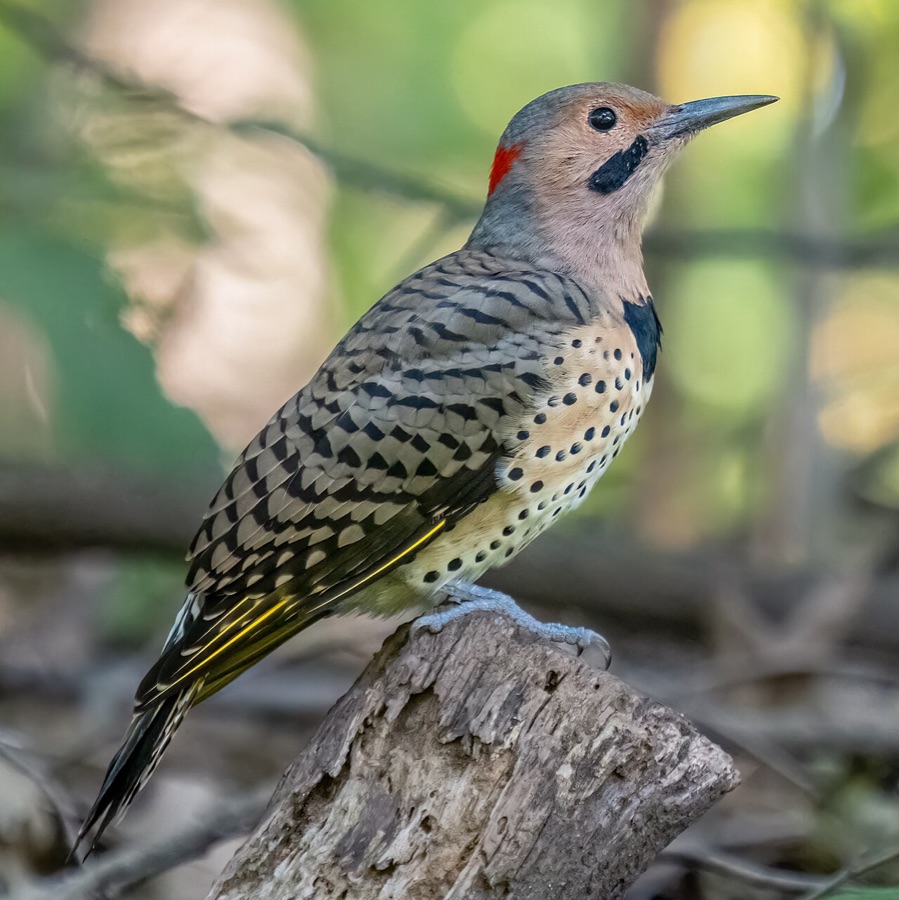
Large brown woodpecker with a black chest patch, spotted belly and bright yellow or salmon underwings. Yellow-shafted in the east, Red-shafted in the west.
Often confused with
Pileated Woodpecker — Pileated is much larger, mostly black with a red crest; flicker is brown and spotted.
One thing to watch
A hanging suet cage often fails. A low tray or untreated lawn does more.
The ant specialist
Audubon's line is unambiguous: the Northern Flicker probably eats ants more frequently than any other North American bird. The diet is mostly ants and other insects, plus beetles, termites and caterpillars, with many fruits and berries especially in autumn and winter, and seeds and nuts at times.
That is why it forages by hopping on the ground — the behaviour that makes people think they are looking at something other than a woodpecker. It also climbs trunks and limbs and occasionally flies out to catch insects in the air.
Yellow-shafted or Red-shafted?
These were once considered separate species and interbreed freely where their ranges meet. In the western Great Plains there is a broad zone of intermediates.
Yellow-shafted (east and north)
- Bright yellow underwings and tail
- Red crescent on the back of the head
- Tan face, gray crown
- Male has a black mustache stripe
Red-shafted (west)
- Salmon-pink underwings and tail
- Gray face, brown crown
- Male has a red mustache stripe
- Often migrates shorter distances, moving downslope
Migration differs by form
This is a useful detail if you are tracking when flickers appear. Audubon describes northern Yellow-shafted birds from Alaska and Canada as strongly migratory, most travelling east and then south, with big flights down the Atlantic Coast in autumn, migrating by day. Red-shafted birds often migrate shorter distances, moving southward and from mountains into lowlands, with some spreading eastward on the Great Plains in winter.
Length is 11–12 in (28–31 cm), weight 4–6 oz (113–170 g) — substantially bigger than a Downy or Hairy.
Common questions
Why is a woodpecker on my lawn?
Because it eats ants. The Northern Flicker forages by hopping on the ground, and ants are a major part of its diet.
Will it come to a suet feeder?
It can, but a low tray or low-mounted cage is a better match for a ground-foraging bird. Fruit is also taken, especially in autumn and winter.
What is the difference between yellow-shafted and red-shafted?
Underwing and tail colour, face and crown colour, and mustache colour. They interbreed where ranges meet, so intermediates are common in the western Great Plains.