Woodpeckers
Red-bellied Woodpecker
Melanerpes carolinus
Larger than a downy and often dominates a suet cage. Suet and peanuts are the reliable draws; sunflower is taken when suet runs out.
- Food to offer
- Suet
- Peanuts
- Sunflower
- Feeder that suits it
- Suet cage or hopper
- Size
- Medium
- When to expect it
- Year-round (eastern North America)
- Region
- East
Photos of Red-bellied Woodpecker
3 imagesFeeding Red-bellied Woodpecker at a glance
For someone putting out food for the first time.
What to put out
- Suet
- Peanuts
- Black-oil sunflower
Best feeder and placement
Suet cage or hopper. A substantial cage suits its size.
How it behaves at the feeder
Often dominates a suet cage. Caches nuts in bark crevices in autumn.
How to recognise it
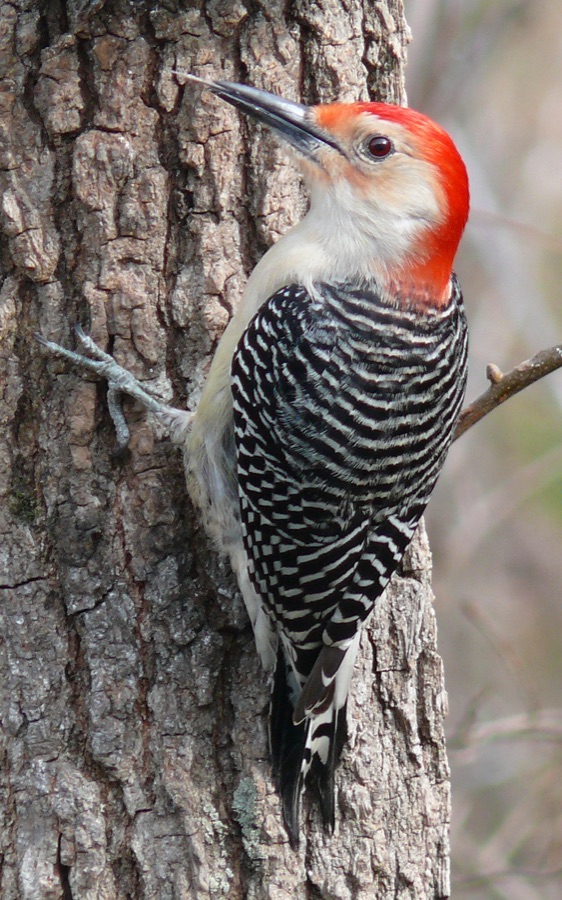
Barred black-and-white back, buffy face and chest. Female has red only on the nape; male has red nape, forehead and crown. The red belly is rarely visible.
Often confused with
Red-headed Woodpecker — Red-headed has a solid red head and a big white wing patch; Red-bellied has a barred back and only partial red on the head.
One thing to watch
Do not be misled by the name — identify it by the barred back and head pattern.
What to look at instead of the belly
Audubon's description is the one to learn: narrow black and white bars on the back, a buffy brown chest and face, and red on the head. The female has red only on the nape; the male has red on the nape, forehead and crown.
In flight the bird shows white patches on the wings and rump. Length is about 9.4 in (24 cm), weight 2–3.2 oz (56–91 g) — robin-sized, and noticeably bigger than a Downy.
An opportunist, not a specialist
Audubon calls the Red-bellied an omnivorous, opportunistic generalist. It eats many insects, but plant material may be more than half the diet at some seasons, including acorns and other nuts, wild and cultivated fruits, and seeds. Occasional items include tree frogs, the eggs of small birds, oozing sap and even small fish.
In autumn it stores nuts and seeds in bark crevices and eats them through winter — which is part of why it is a reliable winter feeder visitor.
The range is moving north
This is one of the more interesting things about the species right now. Audubon notes that the Red-bellied has expanded its range northward in recent decades, has adjusted to life in suburbs and city parks, and is of low conservation concern with a population that seems stable and slightly increasing.
For a gardener, that means a bird that may not have been present a few decades ago can now be a regular. If you are in the northern part of its range, a suet cage is the standard way to bring it in — Audubon notes the species has been known to be attracted to suet feeders.
Nesting numbers
| Detail | Figure |
|---|---|
| Eggs | 2–6, white |
| Incubation | 12 days, both sexes (male at night and part of day) |
| Young leave nest | About 24–27 days |
| Broods | 1 per year in the north, 2–3 in the south |
| Nest height | Usually under 50 ft, but can be as high as 120 ft |
Common questions
Why is it called red-bellied if the belly isn't red?
The name refers to a patch that is usually hard to see in the field. Use the barred back, buffy face and head pattern instead.
Does it migrate?
It is primarily a resident, wintering throughout its range. Audubon notes that northern populations such as those in Michigan may move south during harsh winters, but much is unknown.
What brings it to a feeder?
Suet is the classic offering, and Audubon notes the species is known to be attracted to suet feeders. Peanuts and sunflower are also taken, and its habit of caching nuts makes it a dependable winter visitor.