Woodpeckers
Red-headed Woodpecker
Melanerpes erythrocephalus
A striking bird whose numbers have declined in many areas. It takes peanuts and suet, often caching food, and is less predictable at feeders than the red-bellied.
- Food to offer
- Peanuts
- Suet
- Sunflower
- Feeder that suits it
- Platform or suet cage
- Size
- Medium
- When to expect it
- Year-round where resident; local movements
- Region
- East and centre
Photos of Red-headed Woodpecker
1 imagesFeeding Red-headed Woodpecker at a glance
For someone putting out food for the first time.
What to put out
- Peanuts
- Suet
- Black-oil sunflower
Best feeder and placement
Platform or suet cage.
How it behaves at the feeder
Unpredictable at feeders. Caches acorns and beechnuts and catches insects in flight.
How to recognise it
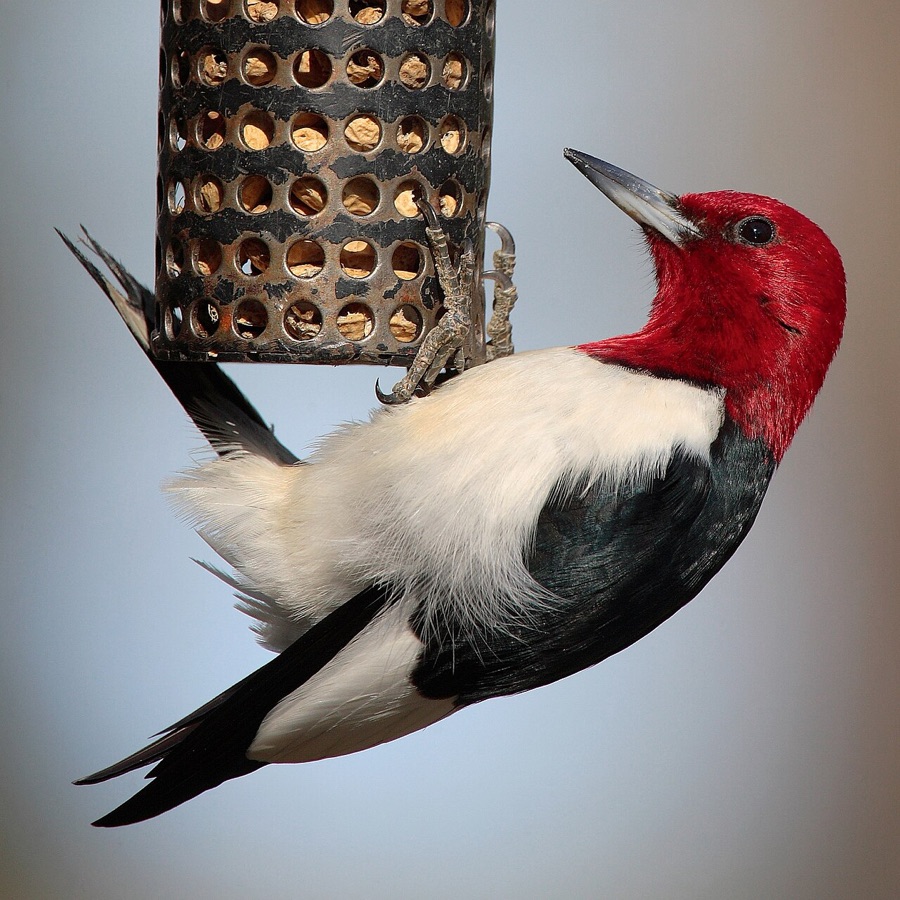
Adults have a solid red head, black back and a large white wing patch. Juveniles have a brown head.
Often confused with
Red-bellied Woodpecker — Red-bellied has a barred back and red only on the nape/crown; Red-headed has the whole head red and a big white wing patch.
One thing to watch
A declining species. Dead standing trees are nest sites; removing them removes the bird.
Unmistakable, if you are lucky enough to see one
Adults are patterned in solid black, white and red with big white wing patches — Audubon calls them unmistakable. Juveniles are the confusing ones: a brown head and dark bars across the white wing patch, with the brown gradually replaced by red during the first winter.
Length is about 10 in (25 cm), robin-sized. It tends to occur in small colonies rather than as scattered pairs, and it is conspicuous when present because of the strong pattern, harsh calls and active behaviour in semi-open country.
Perhaps the most omnivorous woodpecker
Audubon's phrasing is worth keeping: this may be the most omnivorous of the woodpeckers. The diet includes a wide variety of insects, plus spiders, earthworms, nuts, seeds, berries, wild and cultivated fruit, and rarely small rodents. It sometimes eats the eggs and nestlings of other birds, and sometimes eats bark.
Its foraging is equally varied: it flies out from a perch to catch insects in the air or on the ground, climbs trunks and major limbs, clambers about in outer branches, and hops on the ground. In autumn it gathers acorns, beechnuts and other nuts and stores them in holes and crevices for winter.
What this means for a feeder
This is not a bird you can reliably summon. It takes peanuts and suet, often caching food, but it is less predictable at feeders than the Red-bellied. The habitat matters more than the hardware: groves, farm country, orchards, shade trees in towns, large scattered trees — and it avoids unbroken forest, favouring open country or clearings.
If you have large scattered oaks or beeches, you are in the right kind of place. If you have a dense suburban garden with few mature trees, you may simply never see one, and no feeder will change that.
Common questions
How do I tell it from a Red-bellied Woodpecker?
The Red-headed has a solid red head and a large white wing patch. The Red-bellied has a barred black-and-white back and red only on the nape (female) or nape and crown (male).
Does it migrate?
It is a short-distance migrant. Some are probably permanent residents, while others — especially from northern and western areas — travel to wintering areas in the southeastern states. It migrates by day and is not known south of the United States.
Why is it declining?
Audubon says the reasons are not well known, but probable factors are loss of nest sites from cutting dead trees, competition with starlings for cavities, and road mortality when the birds sally out for insects.