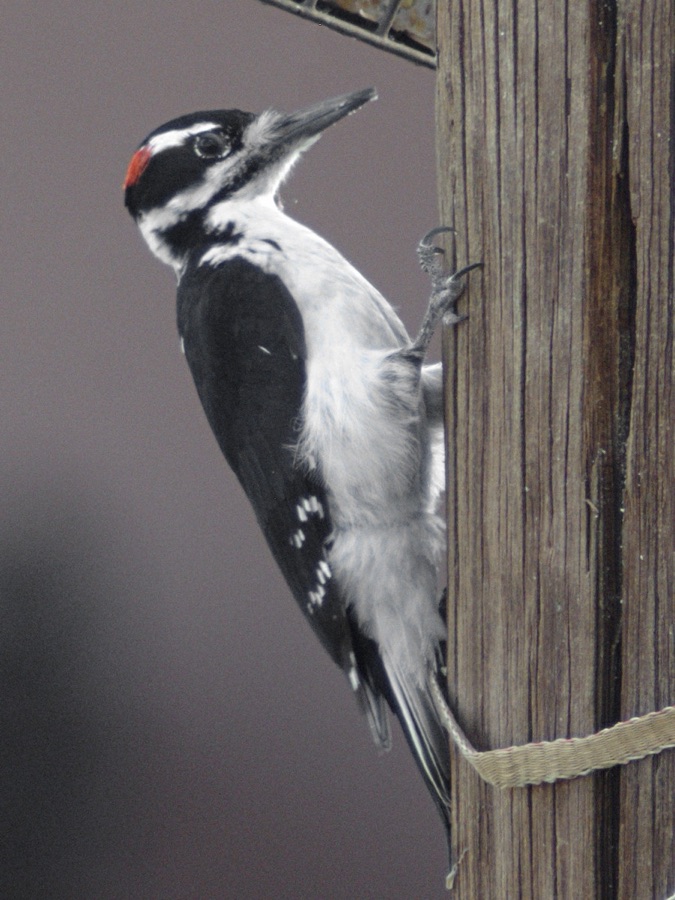
Woodpeckers
Hairy Woodpecker
Leuconotopicus villosus
A larger version of the downy, with a noticeably heavier bill. The two are frequently confused; the hairy's bill is roughly as long as its head.
- Food to offer
- Suet
- Peanuts
- Sunflower
- Feeder that suits it
- Suet cage or hopper
- Size
- Medium
- When to expect it
- Year-round (much of North America)
- Region
- Widespread
Photos of Hairy Woodpecker
3 imagesFeeding Hairy Woodpecker at a glance
For someone putting out food for the first time.
What to put out
- Suet
- Peanuts
- Black-oil sunflower
Best feeder and placement
Suet cage or hopper.
How it behaves at the feeder
Pounds and excavates more than smaller woodpeckers, and needs larger trees nearby.
How to recognise it
Black-and-white woodpecker with a bill nearly as long as its head and clean white outer tail feathers. Male has a red crown patch.
Often confused with
Downy Woodpecker — Downy is smaller with a stubby bill and black bars on the outer tail feathers.
One thing to watch
Less likely in suburbs because it needs larger trees. Mature trees and dead wood matter more than another feeder.
Why the suburbs suit it less
A Downy can work twigs, shrubs and weed stalks. A Hairy forages mainly on the trunks and limbs of trees, and it is energetic about it — probing, scaling off bark and excavating into dead wood in pursuit of insects. That behaviour needs something substantial to work on.
Audubon describes the Hairy as accepting a wide variety of habitats as long as large trees are present: deciduous, coniferous and mixed forest, river groves in prairie country, open juniper woodland, swamps. In the southwest and south into Central America it is a bird of mountain forests, mostly pine.
So if you have a Hairy and a Downy at the same feeder, the difference is often the neighbourhood, not the suet.
Two details beyond the bill
The bill is the fastest identification. These are the next two things to check, both from Audubon's description.
| Feature | Hairy Woodpecker | Downy Woodpecker |
|---|---|---|
| Outer tail feathers | Clean white, without black barring | Black bars on the white outer feathers |
| Length | 7.1–10.2 in (18–26 cm) | 5–7 in (12.7–17.8 cm) |
| Weight | 1.4–3.4 oz (40–95 g) | 0.7–1.0 oz (19.8–28.3 g) |
| Wing spotting (west) | Generally less spotting | More white spotting |
What it is actually after
Audubon is specific: the Hairy feeds especially on larvae of wood-boring beetles, as well as other beetles, ants and caterpillars. It also eats some berries, seeds and nuts, will take sap at damaged trees or sapsucker workings, and comes to feeders for suet.
That last point is the practical one. Suet is the reliable feeder offering, and a cage suits the way the bird works. But the bird's real food supply is in dead and dying wood — which is why leaving a standing dead tree, where it is safe to do so, does more for Hairies than another feeder.
Nesting, briefly
Both sexes excavate the cavity, usually 4–60 ft above ground, mainly in deciduous trees in the east and in aspens or dead conifers in the west. Audubon gives 4 eggs (sometimes 3–6), incubation about 14 days by both sexes with the male at night, and young leaving the nest at 28–30 days — noticeably longer than the Downy's 20–25.
Pairs may form in mid-winter, often with the previous year's mate, and the female's winter territory becomes the focus of the nesting territory.
Common questions
Is the Hairy just a big Downy?
They are closely similar in pattern and often occur together, but they are separate species. Size, bill length and the plain white outer tail feathers separate them. Audubon notes the Hairy does more pounding and excavating in trees than most smaller woodpeckers.
Why do I only get Downies?
Likely the trees. The Hairy requires larger trees and is less likely in suburbs and city parks. Mature trees and standing dead wood nearby make a garden more suitable.
Will a Hairy use a small suet cage?
It can, but it is a bigger, heavier bird than a Downy. A substantial cage is a better fit, and it will still be displaced by larger birds at times.